How to Hire AI Engineers in Vietnam: Updated guidance for 2026
Updated 2026 guidance for hiring AI engineers in Vietnam: roles, hiring models, cost, vetting steps, red flags, and how to scale remote AI teams.
Hiring AI engineers is no longer about cost arbitrage — it's about securing production-ready talent who can scale systems safely. Recently, Vietnam has emerged as a premier AI engineering hub, offering a unique combination of high-level intellectual foundations and a fast-adaptation culture for this emerging industry.
The question is, how can you choose the right team for your project? A bad hire can be an expensive misstep. According to the U.S. Department of Labor, a bad hire can cost at least 30% of the employee's annual salary; in the AI engineering field specifically, it can waste up to 200% of the employee's annual salary.
Navigating this market requires a partner who understands how to recruit local talent while maintaining Western business standards. This guide will help you identify which qualities should be taken into consideration when seeking your next AI-native partner that supports US teams with complex projects, from cloud transformations to production-grade machine learning.
1. Why are US companies hiring AI engineers in Vietnam in 2026?
The shift toward staffing AI engineers in Vietnam isn't just about cost; it's about specialized capability. In 2026, the region will have matured into a sophisticated ecosystem that rivals traditional outsourcing destinations.
- **Elite Technical Talent:** Vietnamese engineers excel in ML, LLMs (Large Language Models), fine-tuning, and MLOps (Azure AI, GCP Vertex AI, AWS SageMaker, etc.) backed by a national focus on STEM education.
- **Exceptional Cost Efficiency:** Companies can often build a full AI engineering team in Vietnam for the cost of a single senior hire in San Francisco or New York. When compared to its peers in Asia, it is noticeable that Vietnam still has competitive pricing while offering the equivalent of high-quality service.
- **Remote-First Alternative:** With a strong culture of English proficiency and experience in AI engineers for US companies, the time zone gap is bridged by robust async workflows.
- **Maturing ecosystem:** From government-backed AI initiatives to a surge in tech startups, the infrastructure for innovation is already in place.
2. What types of AI engineers staffing Vietnam can you hire?
When looking to hire AI developers in Vietnam, you can find specialists across the entire AI lifecycle. A standard AI development team in Vietnam usually offers full-stack options, which could easily meet your demands, consisting of:
- Machine Learning / Deep Learning Engineers: For custom model architecture.
- LLM / Generative AI Engineers: Specialists in RAG (Retrieval-Augmented Generation) and prompt engineering.
- Data Engineers & Scientists: Essential for building the pipelines that fuel intelligence.
- MLOps & AI Infrastructure: Ensuring models are scalable, monitored, and secure.
3. Brief Comparison Between Different Ways of Hiring AI Engineering Staffing in Vietnam
There are four primary paths to securing a Vietnam AI partner. Depending on your final goals, the table below demonstrates a comparison between four common options when it comes to choosing the right teams for your next project.
| Model | Best For | Pros / Cons |
|---|---|---|
| Direct Hire / EOR | Long-term local presence | **Pro:** Direct control. Quality assurance. **Con:** High administrative overhead. |
| Freelance Marketplaces | Small, one-off tasks | **Pro:** Cheap. Easily found on online recruiting spots. **Con:** High risk of quality inconsistency. It might overlap with the US's working hours. |
| Staffing Agencies | Filling internal gaps | **Pro:** Fast, affordable price range. **Con:** The agency may not understand specific AI nuances, which could affect the outputs. |
| Long-term AI Partner | Scalable, high-impact products | **Pro:** A long-term, trusted partnership between two parties. **Con:** May cost more, depending on company size and operational tendencies. |
4. Estimated cost to hire AI engineers in Vietnam
Choosing to hire AI engineers in Vietnam offers significant arbitrage. While a senior AI lead in the US might command $250k to over $378k annually, equivalent talent in Vietnam typically comes at a much lower cost, without sacrificing output quality.
To summarize, there are typically three types of hiring costs you need to consider, which are:
- **Cost Drivers:** Pricing is influenced by seniority, the specific AI stack (e.g., PyTorch vs. specialized LLM frameworks), and the engagement model.
- **Managed vs. Staff Aug:** While staff augmentation is cheaper upfront, a managed AI engineer staffing Vietnam model, like that offered by CoderPush, reduces "hidden costs" by handling vetting, HR, and rapid ramp-up.
- **Management overhead:** To avoid the high cost of misalignment, companies are increasingly investing in Bridge System Engineers, specialized roles that translate complex business logic into high-dimensional data requirements, ensuring that the expensive engineering hours aren't wasted on unscalable prototypes.
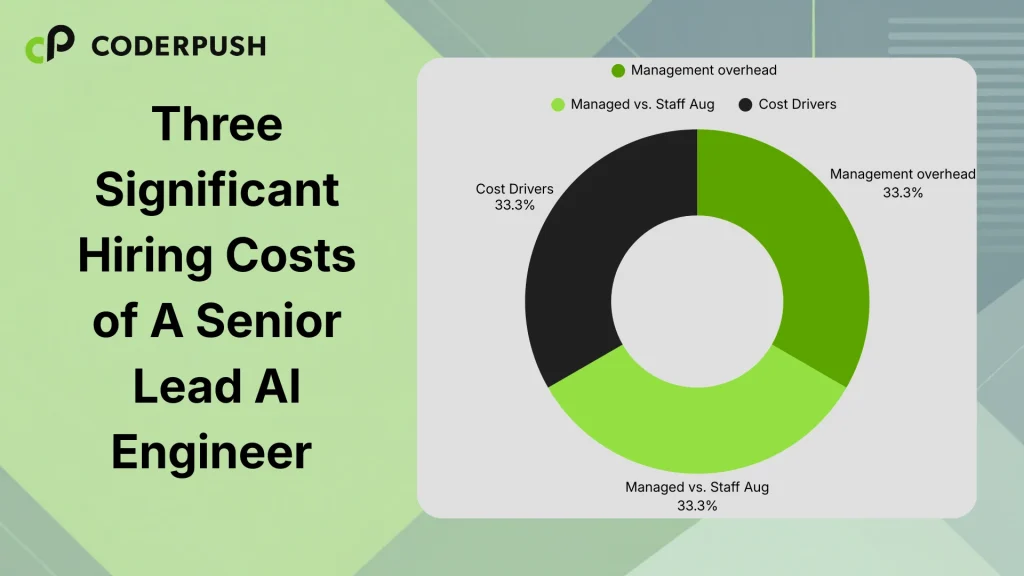
*(Managing hiring costs for a Senior AI Lead Engineer may require accounting for seniority, management overhead, and engagement model, not just hourly rate.)*
5. A Detailed Process for Hiring AI Engineers at Vietnam-Based Development Companies
Finding a developer who can code is simple; identifying an AI engineer for US companies who understands the connection between scalable architecture, data integrity, and specific business objectives is a far more complex endeavor. As enterprise demand for machine learning integration reaches an all-time high, organizations must move beyond traditional hiring metrics to secure professionals who offer both mathematical rigor and a deep-seated understanding of ROI.
Therefore, before making your decision, you should understand some of the crucial angles by asking yourself the following questions:
1. **Define the Scope:** Clearly outline your AI problem, whether it's predictive analytics or a generative UI. In addition, identifying your industry will help you map out which outsourcing companies are good for you, as they might perform better in specific industries like medical, SaaS, digital products, or e-commerce. 2. **Choose Your Model:** Decide if you need an individual developer or a full AI development team in Vietnam. This relies on the project's complexity, accuracy, and scope. 3. **Shortlist Partners:** Evaluate specialized firms alongside generalist vendors. As AI systems become more autonomous, the standardized approach often leads to a technical burden when it might not completely tailor to your specifications. 4. **Technical Assessment:** Once you have your desired team, conduct rigorous system design interviews and code reviews to see if the goals align with the other party. 5. **The Pilot:** Never start a project with a long-term contract. Start with a 4–8 week engagement to test the collaboration and give you opportunities to step back and witness operational procedure. 6. **Scale:** Once the workflow is proven, expand your AI engineering Vietnam footprint. Treat your expanded team not as a "remote resource," but as a primary R&D engine.
6. What are some "red flags" you should avoid when you are looking for an AI engineer company?
To protect your ROI, look for these five critical red flags during your vendor evaluation.
1. **Only "Demo Notebooks," No Production Deployments.** If a vendor's portfolio is filled with Jupyter Notebooks and promising outcomes rather than live, integrated applications, they are likely stuck in what Gartner calls "Pilot Purgatory" — a good start, but cannot be executed properly. Senior AI engineering in 2026 isn't about getting a model to work once; it's about making it work for 100,000 concurrent users. 2. **No Clear MLOps Workflow.** A company without a dedicated MLOps strategy is likely to build you a "disposable" product, easily replaced within a short period of time. AI models are not "set it and forget it"; they suffer from Model Drift and Data Decay. A competent partner should mention how they handle model versioning, automated retraining, or latency monitoring, or else your system will likely degrade within months of launch. 3. **Overemphasis on Low Hourly Rates.** In the 2026 market, you get exactly what you pay for. A low hourly rate often signals a "wrapper-only" approach, or even leads to astronomical "hidden costs" in the form of high token usage, data leaks, and eventually, a total rebuild. Although it's common to prefer those who offer a lower price than the average, it's recommended that you take a broader vision, ask more questions to clearly understand their work ethic, before making decisions.

*(Always check total cost before deciding to collaborate with any company.)* 4. **No Architecture Diagram.** Without a visual map of the system, you cannot audit for security, scalability, or cost-efficiency. Architecture is the "blueprint" of AI. A senior AI-first engineering team will always lead with a diagram that explains how data flows from your legacy systems into the vector database and how the orchestrator handles multi-agent reasoning. 5. **Weak Documentation Practices.** With the EU AI Act and new US transparency standards now in full effect, documentation is a legal requirement. Documentation should cover more than just code comments; it needs to detail Data Lineage, Model Bias Audits, and Inference Logic. If a company can't provide such information or any legal approach to ensure legal compliance, that is a major red flag that might be counted as a hidden cost you have to deal with later on.
7. How do you evaluate an AI development company in Vietnam?
In 2026, Vietnam as an AI partner has transcended its reputation as a cost-effective outsourcing hub to become a premier talent pool for high-end AI research and agentic systems. To ensure your investment is worth the price, focus on these four pillars:
- **Technical Depth:** Do they have an AI-native mindset, or are they just rebranding web developers?
- **Proven Work:** Look for production-grade case studies and client retention rate. Usually, a high retention rate indicates effective collaboration in the past. While it is not as compelling as other metrics, it's still a persuasive track record that demonstrates companies' capabilities.
- **Transparent communication:** Ensure they have a flexible workforce, preferably a remote-first culture with high English proficiency to communicate effectively with International clients.
- **Reliability:** To become strategic partners, one should have a proven track record, as evidenced by an extensive portfolio that demonstrates adaptability. For example, CoderPush has delivered 50+ global projects with a team of 70-90+ engineers, providing a comprehensive approach to solve diverse and complex requirements from foreign partners.
8. How do you manage and scale a remote AI team in Vietnam?
A successful AI development company in Vietnam relies on "Rituals over Rules." Working overseas might lead to another problem: the difficulty in managing a workforce that doesn't share the same culture or language. While it is challenging, applying the three tips below could help you tackle problems better, ensuring smooth operations and quality product deliveries.
8.1. Collaboration: Agile as the Heartbeat
In AI development, where outcomes are not binary, constant feedback loops are a must.
Use structured Sprints and Demos to ensure the Vietnam team is not just coding, but proactively comes up with solutions. A weekly "Live Demo" of model performance builds immediate trust and allows for rapid course correction.
Applying tools like Slack, Notion, and Linear enhances transparency and inclusive communication. Every decision, architectural change, and data pivot must be documented in real-time to ensure the US-based stakeholders are never informed last.
8.2. Tooling: Standardizing the MLOps Pipeline
Standardizing your MLOps stack (e.g., Kubeflow, MLflow, or Weights & Biases) early ensures that a model trained in Ho Chi Minh City can be deployed and monitored in the US without friction.
Implement CI/CD for ML to validate model accuracy and data integrity at every commit. In addition, ensure the Vietnam team has secure, low-latency access to the same datasets as your local engineers.
8.3. Scaling: The "Crawl-Walk-Run" Framework
Scaling is a strategic progression, not an overnight expansion. A phased approach mitigates risk while building deep domain context within the offshore team. Start with one or two AI engineers first to carry out projects at the first stage; once it's off to a good start, expand your team into a well-rounded organization.
9. FAQ: Hiring AI Engineers in Vietnam
- **How long does it take to build a team?** With a partner like CoderPush, a squad can be operational in 2–4 weeks.
- **How is IP protected?** Contracts are typically governed by international standards with strict IP transfer clauses.
- **Why should I choose CoderPush over freelancers?** An AI development company in Vietnam provides institutional knowledge and accountability that freelancers simply cannot match. CoderPush is proud to be a pioneer in AI development in Vietnam, bringing your ideas into outstanding projects, and being a strategic partner on a global scale with an 80% retention rate.
- **How do I prevent hidden cloud costs when hiring offshore AI engineers?** The hidden cost of "cheap" offshore labor is technical debt. Ask for real-time cost dashboards and proactive optimization reports, ensuring your AI roadmap remains a profit center, not a cost center.
10. Ready to hire AI engineers in Vietnam with CoderPush
The window to gain a competitive advantage through AI engineering in Vietnam is open. By combining high-caliber talent with favorable economics, US companies can innovate faster than ever.
CoderPush is a premier AI development company in Vietnam that helps US teams design, build, and scale senior AI squads. We support US product teams with production-ready AI systems and cloud-native engineering practices.
Ready to design your AI hiring plan? Schedule a 30-minute AI architecture review with our team today.